
What is exceptional teaching? This is a question that, as a teacher trainer, has preoccupied me for the last 40 years. What makes an exceptional teacher?

Traditionally education is perceived as a process similar to the production of a MacDonald’s meal. The ingredients are assembled (course books and materials), a methodology is followed and the anticipated outcome is predicted in the form of learning, which is then tested and evaluated.
This is a static, and mechanical view of education. It reduces the teaching process into parts: curriculum, materials, teaching methods and learning outcomes and attempts to apply objective standards to each component. Unfortunately the conception disravels as learners do not behave in a standard manner (unlike ingredients in a MacDonald’s hamburger). Learners are not readily standardised. It is a source of inescapable confusion to academics and administrators that learners defy all attempts at logic and rationality imposed on them.
Furthermore I have noticed that on teacher training courses there is intense reductionist pressure to identify objective teacher competences that are observable and measurable. This obsession with standardisation is evident on the CELTA where, for example, trainee teachers are evaluated against a list of criteria and marked as standard or not to standard. Teachers, of course, are no more malleable to standardisation than learners.

The criteria judges whether a teacher can plan a lesson, and effectively set up the activities, (assemble the ingredients and process them in an appropriate manner). These are basic requirements of a teacher and therefore it is not unreasonable to focus on these in an initial training course. However these are standard competences: what competences measure an exceptional teacher?

Criteria for a Distinction grade at Delta
Let us look at the pinnacle of ELT teaching expertise – a distinction at Delta! This represents the highest practical qualification an ELT teacher can obtain and therefore should describe the competencies of an exceptional teacher. The criteria, however, is surprisingly similar to the CELTA criteria describing the observable processes of planning and executing a lesson. It too mirrors the pattern of producing a MacDonald’s hamburger – assembling ingredients and processing them effectively. Admittedly in this description of an exceptional teacher we have the inclusion of subjectivity: ‘in-depth’ understanding and ‘highly developed’ awareness of learners but essentially the criteria to evaluate a highly experienced exceptional teacher are not dissimilar to those used to rate a ‘standard’ teacher of no previous teaching experience. In this paradigm there are no exceptional teachers and there are no ‘exceptional’ McDonald’s hamburgers – everything congeals around ‘the standard’.
Objective criteria describing teachers’ behaviour (planning and executing lessons) are of limited value in terms of identifying what distinguishes an exceptional teacher. Competences that define teacher’s behaviour are simply stating what a teacher does but avoiding the more subjective judgment involved in how effectively they do it. What is happening under the surface?
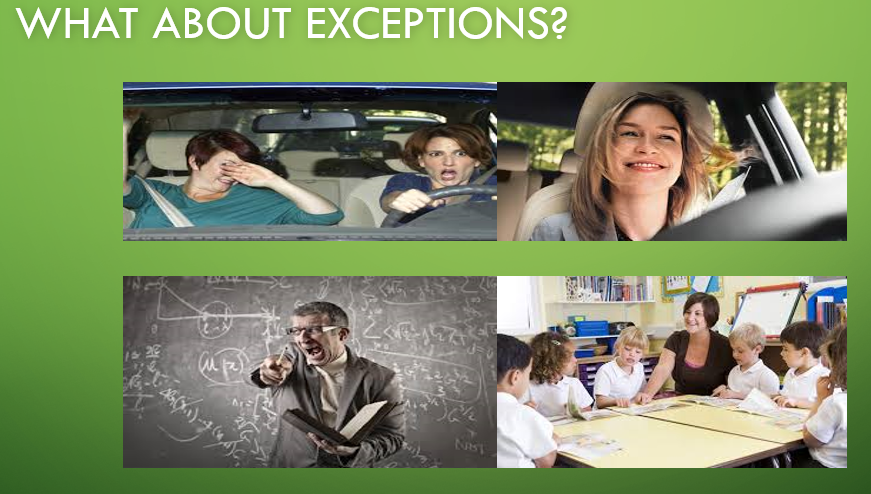
Ticking the boxes on a list of competences does not identify exceptions. All teachers plan and teach lessons. It reminds me of my mother who claimed to be an excellent driver because in her words:”I have never had an accident”. She was a terrible driver.
I am a member of a choir and we have had three choral directors. In terms of their observable behaviour they all tick the boxes in terms of their knowledge of music and how they conduct choir rehearsals. However in terms of their interactions with the choir they are very different. The first was young, dynamic and had an infectious enthusiasm. He was a ‘Caregiver’ who was loved and admired and had a close, easy-going relationship with the choir. The second director was more of a ‘Leader’. He was forceful, arrogant and led by force of his determination and vision. He met with considerable resistance initially but was confident in his own abilities and manipulated the choir into his style through attrition. The third conductor is more passive and focussed on the music rather than relationship building. The choir demanded him to take more of a leadership role and discipline members for not pulling their weight or adopt a more caring, emotional attachment but he was more focussed on the tasks (action). The point is that describing these choral directors in terms of objectifiable competences reveals little and fails to highlight their unique qualities.

Outside education, in other areas of human activity there are noticeable developments: we are running faster, jumping higher, producing more and exploiting technology and artificial intelligence. There is an evolution in human endeavours, so why shouldn’t we be seeking an evolution in teaching and focus on what exceptional teachers are doing? These opening sections are a preamble leading to my response to the question that has preoccupied me for the last forty years: what distinguishes an exceptional teacher from a standard one? If we can not find the answer from behaviour alone we need to explore what is beneath the surface which manifests itself in observable behaviour?
The answer came to me when I considered the question: what causes change or transformation in general terms? What makes a light come on, an apple to fall from a tree or humans to act? These are manifestations of an energy flow, whether electrical, gravitational or other forms. We do not see electricity, radio waves or gravity but we are aware of their intrinsic power by virtue of their effects.
Teachers need to generate energy in the classroom and channel this energy in meaningful ways. All teachers are aware of energy in the classroom, and when it is lacking.

There are three identifiable energy forms that manifest in a classroom: physical, mental and emotional. We are familiar with physical energy and we are well aware that sometimes we are energised and at other times we are tired and listless. We know that if we are to complete an activity effectively we need to feel physically ‘up for it’. Although we can not observe the energy itself, there are observable effects. Energised learners have positive body language, they seek eye contact, their heads are up and they show an awareness of their surroundings. Learners lacking energy are slumped, with heads and eyes looking down and they appear distracted.
The second energy is mental. Again this is not observable but the evidence is very apparent. Learners with their heads down focussing on a problem are using mental energy. It is evident in their body language and also in their progress at completing the tasks. The third energy is emotional energy. Similarly this is evident when learners show their emotions; smiling, laughing, frowning crying. It is also evident from the atmosphere and interaction within the group.
When these energies are fused together and working in harmony – that is when a teacher becomes more aware of themselves, the learners and the context. It allows a group to achieve a state of ‘flow’. Teaching is about making choices and exceptional teachers have an expanded awareness of what those choices are and how they can be utilised in the classroom.

We are familiar with the classes lacking in energy. Learners are tired and listless. There is no engagement with the lesson content or tasks. Without energy, learning can not take place. It needs to be generated either by the teacher, or the learners themselves or the interaction between them.
The Conductor.

Transform through physical energy.
Learning is active. We learn by doing. Learners need to read, write, speak and engage in activities. This energy can either be teacher generated by modelling and mastering behavior or learner generated through activities that encourage experimentation and creativity and interaction. This is perhaps the traditional view of the teachers’ role: the teacher is the master who models the processes for his learners who then aim to imitate the master and develop their skills through extensive practice. It conceives as learning as a craft and reflects the relationship between the master craftsman and apprentice. This balance between guidance and discovery is well documented in EFL methodology. The Conductor transforms through action, he is task oriented and seeks out possibilities for the implementation of ideas and plans of action. The Conductor asks the question: “How can I make this work?”
The Caregiver
Transform through emotional energy

The Caregiver seeks connections, creating relationships, to make communication and sharing of ideas possible. She transforms by building a positive dynamic. The Caregiver asks the question: “What emotional support do my learners need? Effective teaching involves creating dynamic relationships between learners and the teacher. Collaborative learning is more rewarding and motivating than working alone. This energy can be focused by the teacher on individuals personally and uni-directional (ego enhancing) or it can be focused collaboratively to establish a group dynamic and a shared sense of belonging. How we feel about our learning is a crucial determinant of success. A feeling of well being, self-confidence in our abilities and high expectations influence the learning outcomes.
This influence is exercised in accordance with one’s self-efficacy beliefs, which are defined as the extent to which people think their actions will result in success. These beliefs are strong determinants of success (Bandura 2012a).
Low expectations lead to poor performance and high expectations to the opposite. The beliefs of others also has an important influence. Teachers’ expectations of their own competence effects the learning process. Teachers with higher efficacy manage time better (Bouffard-Bouchard et al. 1991), are more persistent when faced with challenges (Bandura and Schunk 1981), perceive more control over student success (Skaalvik 2010), are more committed to their job (Ware 2011) and exhibit greater job satisfaction and less job burnout (Klassen 2010).
The creator
Transform through mental energy

The Creator needs to be imaginative, to break boundaries and rules, to question and challenge. She aims to transform through imagination. She asks the question: “What’s possible?” Cognitive learning theory states that learners improve their understanding of the world by revising their frames of reference. These are shaped initially by social and cultural influences but are amenable to modification when individuals solve problems (instrumental learning) or discuss (communicative learning) while critically reflecting on the assumptions upon which interpretations, beliefs, and habits of mind or points of view are based (Mezirow 1996). Teachers can promote changes in attitudes and beliefs by having learners complete discovery learning exercises, such as projects, role plays, discussions, that engage students with concepts in a way that is relevant and meaningful for students’ lives (Mezirow 1997, 2000).
The Fusionist
Transform by fusion

The Fusionist proposes the vision and establishes shared outcomes. She asks the question: “What is our goal?” Intentional change theory derives from management literature. It involves first establishing an ideal self and a personal vision of the future. This is compared with a ‘real self’ and a learning plan devised to move between the two states by engaging in activities that allow experimentation new behaviours and development of relationships with people who can help progression towards their goal of realizing change.
Transformational leadership is a universal; paradigm for empowering, inspiring, and challenging individuals to transcend their own self interest for the purpose of achieving higher level of functioning *Bass and Riggio 2010)
The transformative teacher is one who is able to generate energy in the classroom and also balance how the energy flows. It requires heightened awareness of the context and the learners. A teacher needs to be sensitive to and aware of the undercurrents of energy to channel its flow appropriately:
- Is direction and attention dissipating and unfocussed? A Conductor intervention is needed to re-establish structure and to model and set up practice activities that keep the learners active in a purposeful manner.
- Is progress becoming too procedural and routine? A Creator intervention is required to open up ideas and fresh possibilities.
- Is the group lacking cohesion and learners not listening to each other, or disrespecting other viewpoints? Caregiver skills are necessary to pay attention to the group dynamics and ensure cooperation and collaboration on tasks.
- Are learners losing their way, questioning the process, undermining the teacher? It is time to assert Fusionist skills and restore a sense of purpose and mission.
The transformative teacher connects knowledge and wisdom, reason and intuition, logic and imagination. It is the space where a balance of the energies in the classroom are utilised.
The energy patterns are not equally balanced within us. As teachers we have preferences and aversions. Sometimes we can underplay an energy pattern by not utilising it – for instance being unwilling to allow too much creativity and exchange of ideas in preference for more teacher centered modelling and practise. Similarly we can overplay a preference. For example a teacher who overplays emotional energy can become overbearing and smother learners. They seek dependency in the learners rather than supporting them to be independent. While appearing to give emotional energy they are in fact seeking it for themselves and suck the strength from others.
Conclusion
I have examined how this energy manifests in the classroom in different guises and describe how these energies can be channeled by teachers and learners to foster learning and development. The power to channel energy effectively explains why some teachers are transformative and effect deep learning while others fail to channel the energy flow effectively.
My purpose is not to describe different roles that teachers perform in the classroom (this has been covered elsewhere in the literature). The aim is to demonstrate how a transformative teacher generates energy and channels it to create effective learning. Rather than focus on static, measureable, observable behaviour and standardising teacher competences, we need to remind ourselves that teachers are dynamic, changeable, vital personalities, each capable of personal development and growth. There are many forms of human energy which commentators from different traditions have identified as ‘chakras’ (yoga), ‘chi’ (Chinese medicine), the holy spirit (Bible), and archetypes (Jung). They emerge everywhere in myth, literature, art, religion and science. They occur at all times and in all places on the human journey. They reside as energy within the psychological unconscious life of people everywhere. They are invisible controlling patterns or metaphors in our consciousness that control how we experience the world.
Balancing the four energies may be applied in many other contexts of interpersonal interaction. All situations of human interaction are dynamic and changeable and a transformative teacher is able to create an energetically balanced and sustainable learning environment.
What is exceptional teaching? My conclusion is that the key distinction is not identifiable by a list of competences or related to knowledge of subject, pedagogic skills or even personality: an exceptional teacher is one who is able to generate energy in the classroom and is a master at channelling this energy to maximise learning opportunities.

 Tom Godfrey
Thank you Tom for this rich information.