Teacher development, teacher training and whole person learning, teacher training courses such as CELTA and DELTA and news from ITI's global community.
The weekend masterclass develops facilitation skills and is aimed at anyone who is involved in training, development and educating others.
Facilitation skills are vital in any event that involves creating a safe space for collaboration where people are interacting and discussing ideas to promote change.
The workshops explore the use of participatory approaches to professional development such as team building, gaining participants’ trust, maximizing engagement and fostering collaboration and personal disclosure.
The workshops are based on the premise that facilitation skills requires ‘presence’ and involves managing the physical, mental and emotional engagement of the participants.
The workshops also explore the use of community forums in personal and professional development. The workshops are adapted from techniques used in Forum Theatre devised by the Brazilian dramatist Augusto Boal.
Participants will learn the methodology and practice the techniques so after the programme they can apply these methods in their own contexts. This methodology provides an innovative framework for conducting professional development in institutions. It is participant centered and the issues are real concerns and challenges that participants face, while providing a safe space to frame the reflections and discussions. The methodology generates multi-voiced, multi-perspectival dialogue and is focused on finding solutions to real problems and inspiring action and change.
Led by Daniel Foley, a professional actor, who has performed in 64 countries worldwide; his one-man shows have received critical acclaim and he is the founding member of his current theatre company “Performance Exchange.” The workshop includes techniques used by professional actors to project, modulate and develop their voice.
Daniel Foley is a well-known Shakespearean specialist. His one man show brings alive all areas of Shakespearean Drama, from the tragic and macabre to the comic and historic with scenes from “Romeo and Juliet”, “Macbeth”, “Hamlet”, “The Tempest”, amongst others, with significant aplomb and participation of members of the audience. Highlights include impersonations of Marlon Brando and John Wayne taking on Shakespearean roles and an insight into some of the techniques used in hand and sword fighting on the stage. Daniel also shares his knowledge of Elizabethan theatre and tests the audience’s knowledge through an interactive quiz.
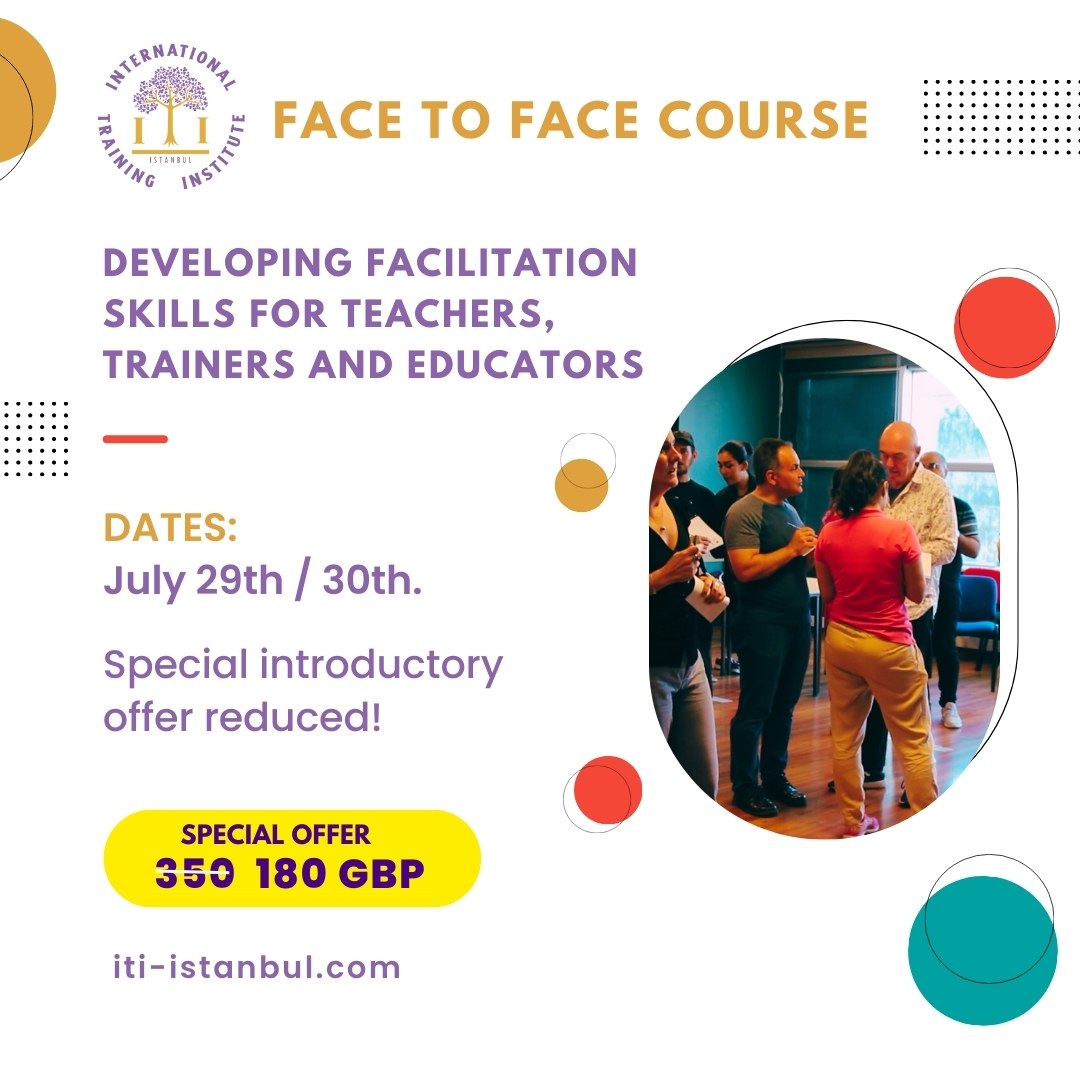
Developing Facilitation Skills for Trainers and Educators
Face to face courses at ITI Istanbul.
The course develops advanced facilitation skills and is aimed at anyone who is involved in training, development and educating others. Facilitation skills are vital in any event that involves creating a safe space for collaboration where people are interacting and discussing ideas to promote change. The workshops explore the use of participatory approaches to professional development such as team building, gaining participants’ trust, maximizing engagement and fostering collaboration and personal disclosure and simultaneously develops a range of many other performative skills. The workshops are structured on tried and proven methodology adapted from the participatory arts and used for training in community settings, care homes, hospitals and many institutions focusing on personal and professional development.
Participants will receive a certificate at the end of the course.
These series of workshops explore the use of community forums in personal and professional development. The workshops are adapted from techniques used in Forum Theatre devised by the Brazilian dramatist Augusto Boal.
Participants will learn the methodology and practice the techniques so after the programme they can apply these methods in their own contexts. This methodology provides an innovative framework for conducting professional development in institutions. It is participant (or company) centered (the issues are real concerns and challenges), while providing a safe space to frame the reflections and discussions. The methodology generates multi-voiced, multi-perspectival dialogue and is focused on finding solutions to real problems and inspiring action and change.
This paper is based on a series of diagnostic workshops conducted at a teacher training centre in Istanbul focusing on how participatory methodology can inform ELT Teacher Education. The workshops provided participants experience of participatory methodology and techniques to elicit feedback on their pedagogic value and efficacy in Teacher Education. Through dialogue and reflection, participants identify the facilitation skills they value from the workshops. While participatory methodology has a long and proven track record in Applied Theatre, education and development, it is rarely utilized in teacher development programmes. In particular we explored the use of Community Forums (an adaption of Forum Theatre) in which participants re-enact collectively experienced challenges in order to find solutions. Feedback from the workshops reveals that Community Forums provide participant-led, solution-oriented, multiple voiced opportunities for reflection and dialogue on critical incidents teachers’ face. Additionally, the workshops aim to initiate transformational change by developing participants’ facilitation skills. The research provides the initial diagnostic data to create teacher development programmes incorporating Community Forums and participatory methods.
1 Introduction.
Having just attended a series of professional workshops I am struck by a worrying paradox. Most ELT trainers and educators, while advocating lessons that are personalised, learner-centred and focus on communication and language use; in practice deliver training sessions that are tutor-centred, material driven (invariably structured by power point slides) that appear to aim primarily at the transmission of content. If trainers and educators do not set an example of how to encourage participatory learning, it is hardly surprising then that teachers often pay lip service to the concept of ‘facilitating learning’ while in reality they are stuck in the traditional conception of a teacher as a transmitter of information. We sorely need a framework and structured methodology for participant-led, solution-oriented professional development workshops.
One solution may lie in the methodology provided by the participatory arts. Participatory arts provide a form of expression which enables shared ownership of decision-making processes and aims to generate dialogue, reflection, and community cohesion. Adapting the principles and rationale of Forum Theatre I explored the use of participatory methodology (and Commubnity Forums in particular) for teacher professional development in a series of workshops at a teacher training centre in Istanbul. Community Forums are an adaptation of Forum Theatre which was developed by the Brazilian educator, dramatist, director Augusto Boal in 1973. Rooted in the Brazilian social movements of the 1950s and 1960s and based on Paolo Freire’s model of participatory education, it is designed to represent experiences of social and political oppression in order to stimulate community dialogue and problem-solving. Over 50 years later Forum Theatre has been shown to work successfully across a remarkable range of cultural, political, and social differences and demands. It has been used by peasants and workers, students and teachers, artists, social workers, psychotherapists, and NGOs, among others; in schools, streets, churches, hospitals, theatres, and prisons.
Community Forums can be seen as a methodology for generating both the participants’ understanding of their situation and the actions to improve them so, in other words, it provides both the content (problems) and the methods to interrogate reflection and elicit solutions. The procedure is relatively straight forward and easy for a novice facilitator to follow after basic training. Participants (teachers in our case) are invited to brainstorm and recall crtiical incidents from their experience of challenges / problems they have faced in their work and then share experiences with each other prior to re-enacting the scenarios in groups in order to reflect and diagnose solutions and alternative courses of action. Having investigated and rehearsed a number of scenarios, these then can be scaled up to a wider community by presenting them to an audience and inviting them to discuss and offer alternative solutions. The workshops aim at the education, personal growth and skills development of the participants as well as providing a diagnostic exploration of the efficacy of applying community forums in a professional development setting.
3 Objectives
My specific objectives for the workshops are fourfold.
1. Diagnostic: To provide an opportunity to experience community forums and to elicit participant-led feedback on their efficacy for teacher education.
2. Methodologic: Related to the above, to evaluate whether the methodology is appropriate and effective in teacher education settings (does it do what it claims to do).
3. Pedagogic: To elicit through dialogue and reflection what participants have learned from the workshops.
4. Transformational: To initiate action or change by providing opportunities to develop facilitation skills for participants to utilize in their own settings.
4 Procedure
The workshops were structured according to two components:
A.) Games and participatory activities and B). Community Forum interrogating the challenges of being an ELT teacher and eliciting creative solutions
A. Games and participatory activities.
The activities are designed to build and/or develop most, if not all, of the following:
The workshop structure relies on participation. Firstly, the workshops are built on the participants’ personal narratives and experiences. Sharing personal stories can be a powerful way of promoting teacher development through the sharing of experiences (McCabe 2002). Secondly it is inherently educational as the reflective and interactive processes promote self-aware, critically thinking participants. It encourages a ‘bottom up’ approach to change that is advocated in much literature on educational innovation and change (Fullan 2007).
The three (3 hour) workshops followed this format.
Workshop 1. Tilling the Soil.
Participants warm up to the concept of self-disclosure through activities in pairs and groups. Then we brainstorm the rewards of teaching before relating a story of positive achievement in groups which provides the stimulus for re-enacting the story through image theatre. In the final hour we repeated the cycle but this time brainstorming – challenges, obstacles, difficulties, and concerns of an ELT teacher.
Workshop 2. ‘Sowing the Seeds’
Participants focus on devising scenes for the community forum scenario. By the end of the workshop we have six scenes and a facilitator/ director allocated to each scene.
Stage 3 ‘Blooming’
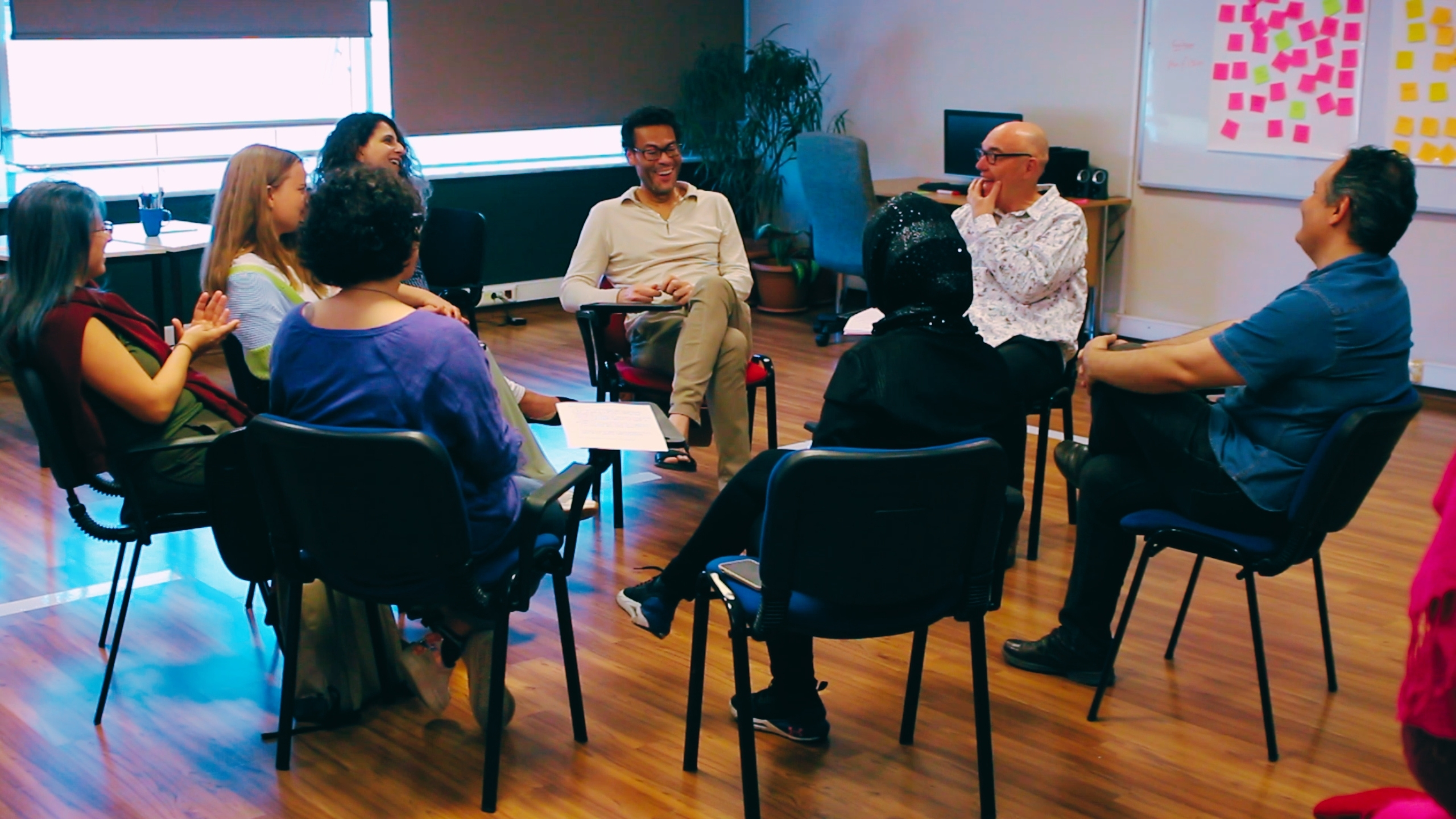
Participants focus on developing facilitation skills and rehearsing the forum scenes. The scenarios are pressented to an audience in the Community Forum. The forum aims to stimulate discussion, reflection and debate amongst the audience who are also invited to participate in the search for solutions to the issues raised.
5 Findings and participant feedback
5.1 Real experiences / challenges
The aim of the community forum was to raise awareness and interrogate the challenges that teachers face and to explore solutions. After the first workshop I categorized these challenges into four groups for ease of reference:
1. Internal challenges (self-doubts, moods, energy levels, lack of confidence / knowledge)
2. External challenges (from administration, management, learners, parents and colleagues)
3. Contextual challenges (low pay, large classes, inappropriate methodology and materials)
4. Cultural challenges (poor communication, long hours, cultural differences)
When planning the workshops, I was concerned that the scenarios presented to the audience would lack authenticity. However, these comments suggest otherwise:
‘It shows the challenges of a teacher. It is nice to know you are not alone experiencing these kind of problems’
‘It mirrors real situations and presents them visually’.
Indeed, one audience member embodied the experience:
‘In the beginning I was so tense and I felt I was exactly the same as Asya (the protagonist), I even felt blank in the first 10 seconds after the show was over. Felt frustrated but then I started thinking how I could help her… things changed. I started to feel more confident. I could think outside the box again. I felt relieved.’
At the end of the second workshop one participant recognized that time and iteration are necessary for depth and wrote: ‘I believe this kind of training will be more ‘fruitful’ if done several times. I mean problems to focus on will get more challenging and therefore the issues raised will be more thought provoking.’
5.2 Metaxis / dramatic distance.
Participants noted that re-enacting the fiction provided space for reflection. Boal (1995, p.43) refers to the term metaxis to describe the idea of living in an imaginary world which creates a dialectic between fiction and reality so knowledge acquired in the fictional world is transferable to the real world through imaginative play. The benefits of drama to provide ‘distance’ was mentioned by participants as in these examples: ‘I think they open some doors and give perspective about real life problems. Watching other people and seeing the problems acted provides a distance from the problem. So I can think better to find a solution.’
When dramatizing critical incidents participants experience a condition of in-between-ness, a liminal space between reality and fiction. This duality creates both tension and imaginative possibilities that are crucial elements in a training context. Through imagining what it might be like to be another, at the same time as being themselves, participants experience ‘me/not me’ (Schechner, 1985). Transformative theories of learning (Mezirow, 1997) propose that learning occurs when the participant faces a challenge, either an accumulation of experiences over time or a sudden trauma. The state of disequilibrium triggers reflection and critical assessment.
5.3 Reflection and Dialogue.
When prompted to consider the benefits for professional development two comments from the audience included:
‘Confidence, talking about the issues via fictional characters makes people feel better (a bit of therapy) becoming more aware of what happens in their schools’.
‘Imagined situations may be perceived as less confrontational’
Each scenario in our performance highlighted problematic issues involving our teacher protagonist facing challenges. At the end of the event, we had a feedback discussion in which the audience reflected on the experience.
5.4 Participant-led.
By delegating content creation to the workshop participants, the conventional power discrepancy is overturned allowing for participant centred input. This flexibility in facilitation allows for creation of a zone of proximal development for the participants and shifts the responsibility for learning from the facilitator to the participants (Vygotsky, 1986). The zone of proximal development is a concept introduced by Vygotsky to describe the space between ‘not able to do’ and ‘able to do’. In this space participants seek solutions with support from the audience.
One key objective of the workshops is to assess their pedagogic value. One factor that emerged was that as the content was participant led, this allowed space for creativity. One participant commented: ‘It was lovely watching the things that were crafted by people, from nothing‘.
5.5 Change and transformation
A key aspect of the methodology is the degree of change and transformation of the participants. In the final workshop I invited participants to comment on how the workshops assisted in their professional development. Many comments referred to the methodology itself; ‘Creating alternative solutions, scenarios, paths of experience’; ‘Exploring issues that concern teachers can clarify things and help find solutions;’ Many participants commented on the relationship between challenge and enjoyment: ‘It was scary at first, but then, it was fun’. In terms of learning and development there is a need for challenge, as Sawyer (1999) highlights: ‘Change is always connected to the willingness to take risks in going beyond what is known and familiar’.
5.6 Scalability
One key advantage of community forums in terms of teacher development is that the procedure can be scaled up to involve large numbers of participants in a short time period. Simply by training an initial modest cohort of 12 community forum facilitators, if these facilitators subsequently conduct workshops for a further 12 participants and then present their community forums to audiences of 200 teachers, within a limited period more than 2,500 teachers will have been exposed to the issues and had an opportunity to discuss and generate solutions. The forums can be expanded to include other stakeholders such as School Principals, learners, and parents. In addition the impact of the forums in terms of audience responses and committment to finding solutions is visible. The forum can be filmed and/ or audience feedback obtained to provide tangible evidence of impact to sponsors.
5.7 Limitations
One audience member recognised that a representative range of stakeholders are needed to have a genuine interrogation of the issues: ‘Through these workshops we can actually educate heads of department, principals of schools, managers and even teacher trainers in order to create a healthier working environment.’
When asked whether institutions would be interested in professional development using Community Forums there was a mixed response. ‘The institutions are interested in making money. I think they don’t care for using professional development that needs a lot of time and costs a lot maybe’.
‘Here is the point, sometimes people prefer the old-fashioned techniques (books, homework and old rules) so they are not accepting new things.’
6 Conclusion
Community Forums operate at the facilitative, open end of the teaching / training continuum and therefore are liable to elicit more fervent participant responses, interaction and dialogue. Community Forums epitomise an interactionist, participatory approach to learning espousing the philosophy that the process of meaningful dialogue and interaction and the flow of ideas is where learning occurs.
We can conclude by revisiting our initial objectives for the workshops.
1. Diagnostic.
The workshops generated reflection and discussion that provided valuable information about participants perspectives of Community Forums and its relevance to their development as teachers.
2. Methodology.
Despite some limitations, such as potential lack of acceptance by institutions and other stakeholders, we can conclude that Community Forums provide participant-led, authentic content to generate solution oriented interventions, reflection, and dialogue of lived experience as well as offering a safe, fictional distance to encourage personal disclosure and multiple perspectives.
3. Pedagogic
Participants identified numerous facilitation skills that emerged primarily through the games and activities. The methodology provides participants opportunities to develop facilitation skills of raising their awareness of self, others and reflect on their beliefs, behaviour and feelings. These facilitation skills are rarely addressed in teacher education where the focus is primarily on a cognitive, instrumental orientation rather than towards a performative-humanistic understanding of “teaching and learning with head, heart, hands, and feet” (Schewe, 2013, p. 7).
4. Transformational
My aim in conducting the workshops is to stimulate action and change. The workshops are a pilot project to explore the efficacy of Community Forums and how to develop the skills of facilitators who can then disseminate the methodology. After my initial diagnostic workshops I have created two short courses: 1) A week intensive training to develop facilitator skills; 2) Three (3 hour) workshops leading to a Community Forum (see Appendix A). The overall aim is to introduce teachers to a range of techniques to raise awareness of the participatory arts in general and the us of community forums in particular and reveal a fresh landscape of creative personalised expression, enjoyment and gratification.
Works Cited
Boal, A., 1995. The rainbow of desire: the Boal method of theatre and therapy. Routledge, London; New York.
Freire, P., 1995. Pedagogy of the Oppressed. Continuum, New York.
Fullan, M., 2007. The new meaning of educational change, 4th ed. ed. Teachers College Press, New York.
Mezirow, J., 1997. Transformative Learning: Theory to Practice. New Directions for Adult and Continuing , Volume 1997, pp. 5 – 12.
McCabe, A., 2002. A Wellspring for development. IATEFL Publications 82–96.
Schechner, R., 1985. Between theatre and anthropology. Philadelphia, PA: University of Pennsylvania Press.
Schewe, M., 2013. Taking stock and looking ahead: Drama pedagogy as a gateway for performative. Scenario: Journal for Performative Teaching, Learning and Research, Volume 8, pp. 5 – 23.
Vygotsky, L., 1986. Thought and language. Cambridge, Massachucetts: MIT.
7. Appendix
Developing Facilitation Skills for Trainers and Educators
These series of workshops explore the use of community forums in personal and professional development. The workshops are adapted from techniques used in Forum Theatre devised by the Brazilian dramatist Augusto Boal.
Participants will learn the methodology and practice the techniques so after the programme they can apply these methods in their own contexts. This methodology provides an innovative framework for conducting professional development in institutions. It is participant (or company) centered (the issues are real concerns and challenges), while providing a safe space to frame the reflections and discussions. The methodology generates multi-voiced, multi-perspectival dialogue and is focused on finding solutions to real problems and inspiring action and change.
Identifying Performative and Meta-Performative Skills pertinent to Teacher Development.
This article is based on a series of diagnostic workshops conducted at a teacher training centre in Istanbul focusing on how Performative Pedagogy can inform Teacher Education. Performative Pedagogy provides embodied, participant-led, solution-oriented, multiple voiced opportunities for reflection and dialogue on critical incidents teachers’ face. In addition, participants highlighted a number of performative skills pertaining to developing awareness of self, others and setting that are fundamentally ignored in current competence-based teacher education programmes. Finally participants uncovered meta-performative skills revealing aspects of their identity and reflection on why teachers act in the way that they do.
Background to the workshops
I work in a teacher training centre in Istanbul training pre-service and in-service teachers from a spectrum of cultures and linguistic backgrounds. The environment demands self-aware, reflective teachers who are collaborative, demonstrate inter and intra-personal qualities, adaptable, able to embrace diversity in multi-cultural and multi-linguistic contexts while solving emergent problems, adopting a range of roles and in most cases having to perform in a language which is not their mother tongue. Typically, the teacher education they receive focusses on cognitive, instrumental and propositional knowledge leaving them often feeling ill-equipped, disillusioned and ill-prepared to meet the behavioral challenges of teaching a class in situ. To fill this gap, I have turned to performative pedagogy and to an examination of its applicability to teacher education.
Performative approaches to learning demands skills that combine physical, cognitive and affective domains. Teaching is performative in that it is based on judgements formed through action (heuristic); it is influenced by contingencies that happen in real time and are unpredictable (improvised); it involves physical and emotional engagement (embodied) and learning is created in the process (emergent). “Teachers are taught how to instruct but not how to engage their students emotionally”. (Wahl, 2011, p. 21).
Post pandemic it is opportune to consider the importance of the embodied physical presence of learners and teachers in the learning encounter as this raises fundamental issues as to the nature of teaching and learning. Teachers are rarely trained in skills to assist them to be physically present, emotionally aware and able to improvise creatively to emergent needs. The potential of embodied methodologies and the need to acquire performative skills is ignored in teacher education which remains firmly entrenched in a competence driven paradigm. Metaphorically teacher education provides ‘the map’ (the official version of the journey route) but omits ‘the story’ (the feelings of the journey’s experience).
Research on teacher education has moved somewhat from defining what a teacher is, does or believes to a more ‘bottom up’ perspective of examining how teachers learn (Allwright 2001). Despite a move to more teacher introspection, teacher education is still rooted to the assumption that teachers need core disciplinary knowledge (Yates and Muchisky 2003) and knowledge of pedagogic skills which will be moulded into expertise through classroom experience. In contrast the underlying philosophy behind performative pedagogy is that there is a direct relationship between affective, cognitive and physical domains so we need to ‘feel’ something as well as understand it. Vygotsky refers to ‘perezvanhie’ a Russian term meaning ‘learning through experience’. In other words, we need to experience the state of confusion (liminality), a state of being in limbo between knowing and not knowing, before transformation is possible. Development is conceptualized as participatory, action oriented, holistic and requires a performative-humanistic understanding of ‘teaching and learning with head, heart, hands and feet’ (Schewe, 2013).
Definition of Performative.
The term ‘performative’ was first coined by Austin in 1962 to refer to a limited set of verbs that both describe and require the performance of the act simultaneously: ‘I name this ship Titanic’. The term was picked up 20 years later by Postmodern thinkers (Derrida, Habermas, Bourdieu) who re-defined ‘performativity’ to include any iterative action that involves social interaction and presence (embodied), indeed any action that involves people coming together to communicate meanings and affirm cultural and social values (i.e. protest marches, sports events, political rallies, concerts). Today with the advent of Performance Studies performativity has a wide remit encompassing gender, race and has opened up significant ways for rethinking language and identity.
Features of Performative Pedagogy.
Performance pedagogy has evolved from ‘drama in education’ (pioneered by Heathcote in the 1960s) and is inherently participant centred. The key characteristics are role playing, improvisation, context specific topics and reflection and discussion on the part of the participants. Like Heathcote, the dramatist Augusto Boal’s philosophy (as depicted in his book ‘Theatre of the Oppressed’) involves learning through re-enactment of scenarios but differs in that learning starts with an awareness and analysis of the present context (oppressions) and involves re-enactment and reflection to uncover solutions and promote action/ change. Boal’s methodology is indebted to his mentor the pedagogue Freire who foregrounds the movement of powerless (oppressed) people from being acted upon (objects) to initiating action and becoming subjects of their own lives. For Freire this process of ‘conscientization’ is dependent on replacing the banking system of education (filling learners with the academy’s version of knowledge) with a dialogic approach to learning. So, while Freire broke the hierarchical divide between teacher and student, Boal did so between performer and audience and by extension performative pedagogy conducts a similar dismantling of the positioning of Teacher and Teacher Educator.
The Findings
These workshops, by identifying the performative and meta-performative skills required by teachers contributes to both the participants’ personal development as well as informing Teacher Education in general. No doubt that becoming more aware of who you are and where you are going is key to professional development. Teachers share experiences and commonalities, become more comfortable with personal disclosure, and come to experience and enjoy a new level of articulation and self-efficacy.
Workshop Objectives
1. Diagnostic.
The workshops generated a lot of written data, oral reflection and discussion that provided valuable information about participants perspectives of Performative Pedagogy and how it is relevant to their development as teachers.
2. Methodology.
Performative Pedagogy provides participant-led, authentic content to generate solution oriented, embodied interventions, reflection, and dialogue of lived experience as well as offering a safe dramatic, fictional distance to encourage personal disclosure and multiple perspectives.
3. Pedagogic
Participants identified numerous performative and meta-performative skills that emerged primarily through the workshop activities. The methodology provides participants opportunities to develop performative skills of raising their awareness of self, others and their context and reflect on their beliefs, behaviour and feelings while performing the activities (meta-performative).
4. Transformational
There is a need for training in performative methods and for educational practices to understand the potential of the arts in transforming consciousness, refining the senses, and enlarging the imagination, and requiring teachers with awareness of performative skills. Performative Pedagogy introduces teachers to a range of techniques to raise awareness of the performative and reveal a fresh landscape of creative embodied expression, enjoyment and gratification.
References
Allwright, R, 2001. Three major processes of teacher development and the appropriate design criteria for developing and using them, in: Research and Practice in Language Teacher Education: Voices from the Field. CARLA, Minneapolis, pp. 115–134.
Schewe, M., 2013. Taking Stock and Looking Ahead: Drama Pedagogy as a Gateway to a Performative Teaching and Learning Culture. Scenario 2013.
Yates, R., Muchisky, D., 2003. On Reconceptualizing Teacher Education. TESOL Quarterly 37, 135.
Wahl, S., 2011. Learning to teach by treading the boards. In Key Concepts in Theatre/Drama Education (pp. 19-22).
This is a blog for teachers interested in teacher education, teacher training and development, teaching and learning and related topics. We will be inviting a variety of people to share their experiences on a regular basis – so keep coming back!.
The latest post is by Galina an ITI DELTA student working in Samara, Russia. She describes the three-day ITI Master Classes held at her University. Liz and I had a wonderful time and thank Galina for inviting us and also writing it up for our blog.
I have written the first two posts to get the ball rolling. My first post is about ‘whole person learning’ and explains my personal philosophy that learning should utilise the whole person in terms of stimulating the mind, body and emotions.
My second post is also personal and describes my experiences over the last two years facing cancer. Like staring down from a precipice, confronting our fragile mortality is terrifying, and yet, at the same time by confronting the inevitable, it provides a unique opportunity to perceive from a new and sharper perspective and to learn valuable lessons about the nature of learning and life.
The Game of Tag That Becomes a Mirror for Teachers
How a simple running game exposes burnout, ambition, and the hidden pressures shaping your teaching.
In my Teaching Artistry workshops, I sometimes begin with a game.
A running game.
Arms linked. Laughter. Energy rising.
It looks like something from a primary school playground.
It isn’t.
Within minutes, it becomes a metaphor for life, leadership, and why we became teachers in the first place.
The Game: Cat and Mouse
Participants link arms in pairs, forming a human chain.
One person is the cat (the chaser). One person is the mouse (the chased).
The cat runs. The mouse escapes.
The mouse is safe if they hook onto a linked pair. That releases someone else — who instantly becomes the new mouse.
Chaos. Speed. Laughter. Adrenaline.
And then the shift.
The Question That Changes Everything
After 10–15 minutes, breathless and smiling, I ask:
How did it feel to be chased?
How did it feel to chase?
Which role did you prefer?
What thoughts ran through your head?
Then the deeper question:
In your life, are you chasing — or being chased?
The room gets quieter.
Because suddenly it’s not a game anymore.
What It Reveals
This simple activity surfaces powerful dynamics:
urgency
fear
competitiveness
avoidance
collaboration
reliance on others
Some teachers love the thrill of chasing.
Others feel uncomfortable being pursued.
Some desperately look for safety. Some hesitate to join a pair.
It becomes a live metaphor for:
ambition
burnout
purpose
escape
belonging
What are you running towards? What are you running away from?
And how does that relate to why you’re here?
Variations That Deepen the Mirror
We sometimes play Stuck in the Mud.
When tagged, you freeze — legs apart — until someone crawls through to free you.
Suddenly the focus shifts:
Who helps? Who notices? Who leaves others stuck?
Or Linked Arms Tag.
When tagged, you link arms with “it.”
The chain grows.
Eventually, everyone is connected.
It stops being about speed.
It becomes about unity.
Why This Matters for Teachers
These are not icebreakers.
They are diagnostics.
They reveal:
how we relate to pressure
how we respond to being pursued
how we support others
how we seek safety
how we experience competition
Teaching is often described as intellectual work.
But it’s also embodied.
We chase targets. We feel chased by deadlines. We look for safety in institutions. We link arms with colleagues — or we don’t.
Sometimes it takes a “children’s game” to surface what we’re really feeling.
This Is the Kind of Work We Explore
In the Performative ELT community, we explore activities like this — not as entertainment, but as reflection.
We ask:
What does this reveal about who I am as a teacher? What patterns am I repeating? Where am I running — and why?
If you’re interested in embodied, experiential approaches to teacher development — the kind that go beyond methodology and into identity — you’re warmly invited to join us.
The leader must never stop completely. The follower must never lose alignment.
Very quickly:
bodies bend into unusual shapes
forgotten muscles wake up
laughter mixes with discomfort
concentration sharpens
Then they switch.
Leader becomes follower.
Control becomes surrender.
Later, both extend a hand at the same time — becoming leader and follower simultaneously.
And that’s where it gets interesting.
What It’s Really About
On the surface, it’s a movement exercise.
In reality, it’s about:
focus and presence
spatial awareness
non-verbal communication
empathy
responsibility
power
It exposes how we relate to control.
Some participants love leading.
Others feel anxious holding responsibility for someone else’s body.
Some relax when following.
Others resist being directed.
In a few minutes, patterns emerge.
The Questions That Matter
After the movement, I don’t analyse technique.
I ask:
Which did you prefer — leading or being led?
Why?
Was it easy to trust your partner?
What helped it work well?
What made it difficult?
And then the deeper question:
How does this relate to how we teach?
Because teaching is a constant negotiation of:
authority and agency
guidance and autonomy
control and trust
In classrooms, we lead. We invite. We structure. We respond.
But do we always notice how much control we hold?
Or how much we struggle to release it?
Why This Matters for Teachers
Colombian Hypnosis is not about theatre.
It’s about awareness.
It surfaces:
our instinct to dominate or withdraw
our comfort with vulnerability
our ability to read others non-verbally
our tolerance for uncertainty
And it reminds us that facilitation is embodied.
Before it’s a strategy, it’s a stance.
Before it’s a method, it’s a relationship.
This Is the Kind of Work We Explore
Activities like this aren’t icebreakers.
They’re mirrors.
They help teachers reflect on presence, power, empathy, and responsibility — through experience, not lecture.
If this kind of embodied exploration resonates, you’re warmly invited to join our free Performative ELT community.
It’s a space where we share practical activities like this, unpack the theory behind them, and explore what it really means to teach with presence and artistry.
A mingling activity like ‘find someone who’ is an example of an effective warmer activity. And basically there are three stages. There’s the setting up stage where the instructions need to be clear. And you notice that the facilitator was eliciting the instructions and providing examples at each stage. Then there is the task itself where the people stand up and mill around asking each other questions and interacting. And then there is the feedback stage where the facilitator asks for reporting back on what was discovered. So I think the advantages of these kind of activities is that it helps participants gain confidence. They feel relaxed. They start interacting, they start speaking in English, if it’s a language classroom, but even if it’s a training session or a meeting, it gets them going, it sort of activates them.
It gives the facilitator or trainer an opportunity to diagnose the participants, see who they are, what do they know, what are their attitudes. If it’s a classroom, their level of English. it also gets participants to get to know each other as well as the trainer or facilitator. It’s a process of beginning to build a rapport and beginning to encourage self-disclosure. It sets the atmosphere for the course. It kind of says, okay, this is the way we’re going to interact. This is the way the learning is going to happen. And it’s an energizer. It gets people active and participating.
I would like to invite you to join an ongoing practitioner-led research project within the Performative ELT community. The project explores remembered learning experiences and what they reveal about teaching as an embodied, relational, and performative practice.
Why this Research?
When people reflect on their education, they rarely remember lesson plans, materials, or objectives. What stays with them are moments: a teacher’s tone, a reaction to a mistake, an invitation to speak, or a moment of public exposure or care. These moments shape confidence, identity, and long-term relationships with learning.
What are we researching?
Working with thousands of short learning narratives written by teachers, the research asks: • What teaching moments are remembered most vividly? • What do these memories reveal about teacher presence, authority, and emotional climate? • How do embodied and relational aspects of teaching shape learning experiences?
How the research works
Rather than starting with a predefined framework, members of the Research Circle read and discuss real learning narratives together. Through collective sense-making, recurring patterns begin to emerge. These patterns are then named provisionally and tested against further data.
What is beginning to emerge?
Early discussions suggest that remembered learning experiences are strongly shaped by how teachers use voice, respond to emotion, exercise authority, and create (or restrict) psychological safety. These insights are forming the basis of a provisional Teaching Artistry lens.
Get involved
This research is collaborative, open, and ongoing. You are very welcome to follow the project, join discussions, or take part in future research activities through the Performative ELT community.
Join Performative ELT to: • Read follow-up posts and reflections • Take part in future Research Circle meetings • Contribute to practitioner-led inquiry into teaching as performance
Not all forms of teacher development feel alive. Some feel like information delivery. Others feel like compliance. Very few feel like genuine growth.
Performative pedagogy, and the Community Forum approach that sits within it, offers something different. It reminds us that teacher learning is not linear. It moves in loops. It expands, contracts and grows through repetition, experimentation and shared imagination. It is less about content and more about connection.
More than anything, it is about community.
Over the past few years, I have seen how teachers respond when they are invited to engage with their work in embodied, creative and relational ways. When they move beyond talking about their challenges and begin exploring those challenges through story, image and re-enactment. When they stop performing for an evaluator and start rehearsing for reality alongside peers who understand the same daily pressures.
This approach is not simple, and it is not always comfortable. It asks for a shift in mindset.
It asks us to:
• Move from expert-driven delivery to co-created inquiry • Allow space for vulnerability and emotion in professional settings • Build institutional cultures that support participation rather than passive attendance
But the rewards are unmistakable.
When teachers reflect together, act together and imagine together, several things happen:
• They feel genuinely seen and heard • They regain a sense of agency over their practice • They discover solutions that emerge from the group rather than from a slide deck
These moments of shared insight are not small. They often change how teachers relate to learners, to colleagues and to themselves.
What We Have Learned
Across countless workshops and forums, four principles stand out:
Teaching is embodied, relational and performative. Community Forums make space for the full reality of teaching, not just the cognitive side.
Facilitation matters. Effective facilitators create safety, curiosity and collective ownership rather than directing or correcting.
Stories, images and re-enactments reveal what discussion alone cannot. They allow us to understand our dilemmas at a deeper and more emotional level.
Learning is most powerful when it is social and sustained. A community of practice is not an optional extra. It is the engine of growth.
Looking Ahead
The practices described here are not step-by-step instructions. They are adaptable frameworks that you can reshape for your own context. Whether you work in a school, a training centre, a university or a community space, performative pedagogy invites you to rethink your role.
Instead of transmitting information, you become someone who cultivates dialogue. Instead of delivering answers, you help create the conditions for shared insight. Instead of standing at the front, you help hold a circle.
This work is part of a broader shift in education. A shift toward approaches that honour experience, creativity and human connection. A shift that recognises the emotional reality of teaching. A shift that invites teachers to learn in the same meaningful, embodied ways we hope our learners will.
This is not an ending. It is a beginning.
If this resonates with you, consider this an open invitation. The Performative ELT community is a growing global space where teachers explore embodied approaches, share practice, collaborate on research and learn through the same creative processes described here. It is for teachers who want development that feels meaningful, human and alive.
You are warmly welcome to join us and be part of shaping what comes next.


 Tom Godfrey