
Participation isn’t about confidence or motivation.
It’s about how much risk the learning space asks learners to carry.
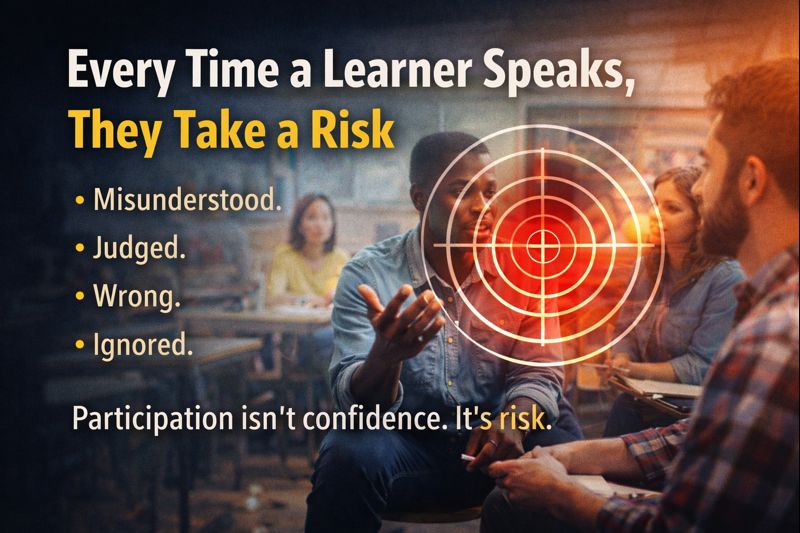
Participation Isn’t About Confidence.
It’s About Risk.
Facilitation isn’t just about getting more people to speak.
It’s about how much risk speaking feels like.
Every time a learner contributes, they risk being:
misunderstood, judged, wrong, or ignored.
How we structure interaction determines whether that risk feels manageable — or overwhelming.
Participation always carries risk
Speaking in a learning space is never neutral.
It involves:
- social exposure
- cognitive effort
- emotional vulnerability
Some learners find this energising.
Others find it threatening.
Facilitators can’t remove risk — but they can shape how it’s experienced.
Think–Pair–Share isn’t a technique. It’s risk management.
Think–Pair–Share works because it sequences visibility:
- Think → private processing
- Pair → rehearsal and support
- Share → public contribution
Seen this way, it’s not a discussion activity.
It’s a way of protecting learners before asking them to be visible.
When sequencing is skipped:
- confident voices dominate
- hesitant learners withdraw
- silence becomes uncomfortable
Sequencing widens access to voice without forcing it.
Open vs closed interaction (and why both matter)
Open interaction
- spontaneous
- unpredictable
- high ownership
- high risk
Closed interaction
- guided turns
- clearer expectations
- lower risk
- less spontaneity
Neither is “better”.
Facilitation is about asking:
Which structure serves this group, right now, for this purpose?
Skilled facilitators move between them — they don’t default.
Role play: powerful, risky, misunderstood
Role play can:
- increase authenticity
- allow experimentation with identity
- shift risk from self to role
But without careful facilitation, it can feel exposing or threatening.
What makes the difference?
- clear framing
- optional participation routes
- preparation time
- reflective debriefing
Structure turns risk into play.
Talking Circles: redistributing voice
Talking Circles deliberately slow interaction and equalise speaking rights.
They:
- protect quieter voices
- foreground listening
- reduce dominance
But only when silence is respected and participation isn’t coerced.
Equality of voice has to be held, not enforced.
This is an ethical issue, not a technical one
When we structure interaction, we decide:
- whose risks are supported
- whose voices are heard
- whose silence is respected
Too much safety leads to passivity.
Too much risk leads to withdrawal.
Facilitation lives in the tension between the two.
A question to take into your next lesson 👇
Are you inviting participation — or managing risk?
(Adapted from Chapter 5 of my Facilitation Skills handbook.)

 Tom Godfrey