
How can we use creative thinking and drama in the language classroom?
I am going to describe 6 drama activities that encourage creative thinking and utilise the learners’ imagination. Drama typically takes place in face to face settings as it involves movement and interaction but these activities can work online using breakout rooms where learners can interact and work together. Although they are originally drama activities, they can be adapted to the language classroom.
What is creative thinking?
Along with critical thinking, creative thinking has become a buzzword as it is one of the ‘so called’ 21st century skills. When we consult Bloom’s taxonomy of cognitive processes, ‘creating’ is the highest order of thinking followed by evaluating and then analysing which are more critical thinking skills. The lowest order of thinking is ‘remembering’. What kind of thinking do we encourage in the classroom? Certainly, when I was a learner learning Latin at school there was a heavy emphasis on memorization and this emphasis on memorising information still has a strong influence on learning today. However learning is more effective when it activates higher order thinking so we need to encourage critical thinking skills and more importantly creative thinking.
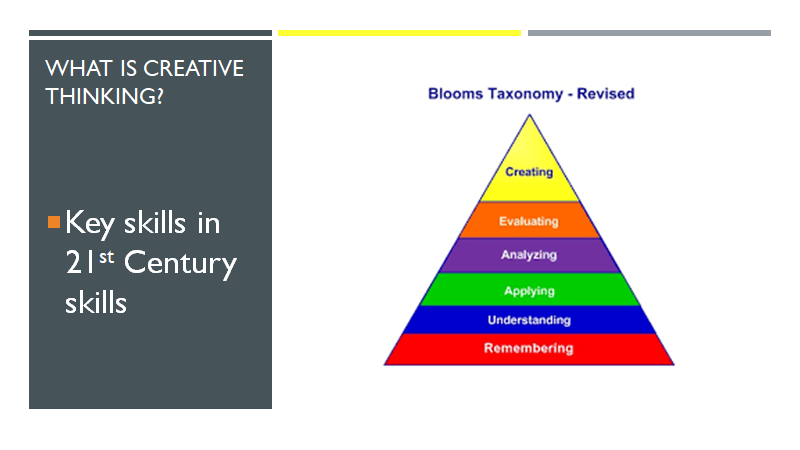
We can divide higher order thinking into convergent thinking and divergent thinking. Convergent thinking is typically critical thinking, in other words analysing and evaluating. We encourage this thinking in the classroom when we do matching tasks, problem solving, gap filling activities. Convergent thinking activities are epitomised by having one correct answer. We can contrast this with divergent thinking.
Divergent thinking is when learners create and generate their own ideas and their own language. They use their imagination and there is no one correct answer. There can be many answers. I think in most classrooms convergent thinking is dominant. Why is this? One reason may be that divergent thinking is unpredictable and for a teacher this involves risk taking because it is not easy to plan a lesson where the language the learners produce is generated by themselves. It makes it more unpredictable. However, it is learner generated creative language that generates much richer and more memorable learning.
Drama and language level
Teachers sometimes say to me, ‘I can’t use drama because my learners are a very low level and they cannot generate their own language or their own ideas’. This first activity is for low level learners with very basic language. For example: ‘my name is,’ ‘I am from …,’ ‘I am a teacher’. Typically in a course book names, nationalities and jobs may be introduced through a context where we have some photographs and a matching activity.
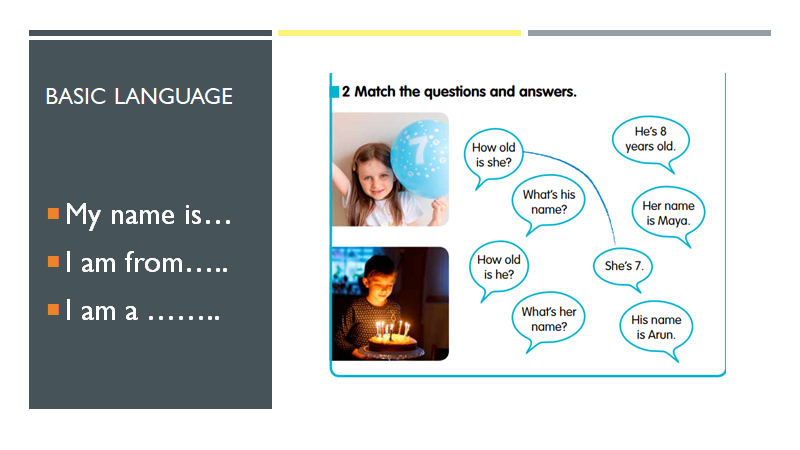
This is an example of a problem solving activity where we have to match the questions and the responses based on the pictures. However, as with many convergent thinking activities, although we have photos of Aaron and Maya, there is no engagement with them and there is no learner language generation. The questions and responses are provided and the task is to match them (a problem solving analytical thinking task but there is no actual language practice).
It is easy to create a language practise activity using divergent thinking exploiting the learners’ imagination and creativity simply by asking the learners to create a character using these questions as prompts.

Then we can put the learners into pairs and they can ask and answer questions based on the character that they have created. For example:
What is your name?
My name is Bond. James Bond.
Where you from?
I am from the United Kingdom
And what is your job?
I am a secret agent 007.
So the learners could take a character from fiction or they may create a character from their imagination.
For example:
What is your name?
My name is Igor Milasovic.
Where you from?
I’m from Russia.
What is your job?
I am mafia boss.
You will notice that the learners when they respond to the questions will start using a different accent, body language, posture and gestures and you could encourage them to use props like a hat or an umbrella or put on a moustache to help them create a new character and stimulate their imagination.
Visualisation
The next activity is visualisation. This is not a drama technique per se but it is a useful way of encouraging the learners to use their imagination. We can start by stimulating interest by using photographs and we tell them that the characters that they have created in the previous activity are going to go on a holiday.
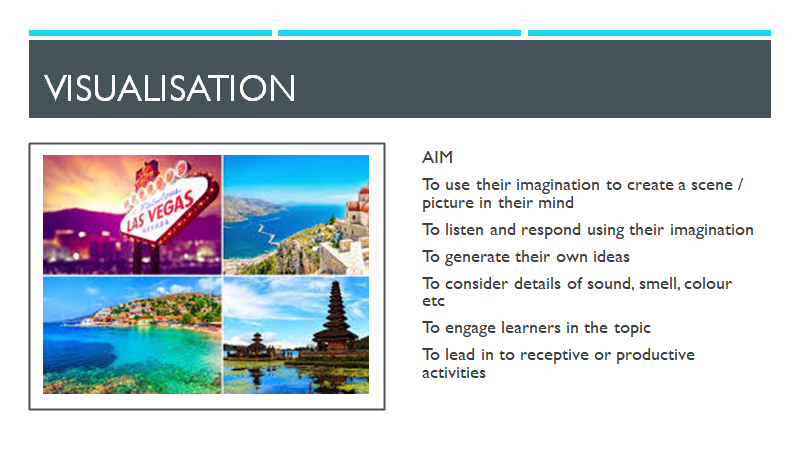
The teacher will say: ‘Okay we’re going to go on holiday in our imagination. We are going to visualise our character on holiday. I want you to close your eyes and imagine you are your character, and you are on holiday. Experience the holiday in your imagination’. The teacher will ask the learners to respond visually, using their imagination to prompts. ‘Imagine you are walking down the street. What do you see? Can you describe the buildings? The people? What’s happening? Listen. What can you hear? Can you describe the sounds? The smells? How does it feel?’ and so on. The learners can go to the hotel, describe the hotel. They can think about what they do. They can think about people who may be with them on holiday. Describe who they are with. Then you bring them back from the holiday visualisation and put them into pairs or groups (in the breakout rooms if it is online) and get them to describe their holiday to each other.
Improvised Role Play
Now we have created a character and we have sent the character on holiday. We have prepared enough material to conduct an improvisation role play. Role plays are very useful for developing speaking skills. In order to develop learners’ oral fluency, they need plenty of practise speaking in a free and improvised manner. If the role play is not set up effectively it can lead to frustration and chaos but when set up efficiently it provides a dynamic engaging, creative learning opportunity. In order to set up an improvised role play learners need to know:
- Who are they in the role play
- Where are they
- What are they doing and why.
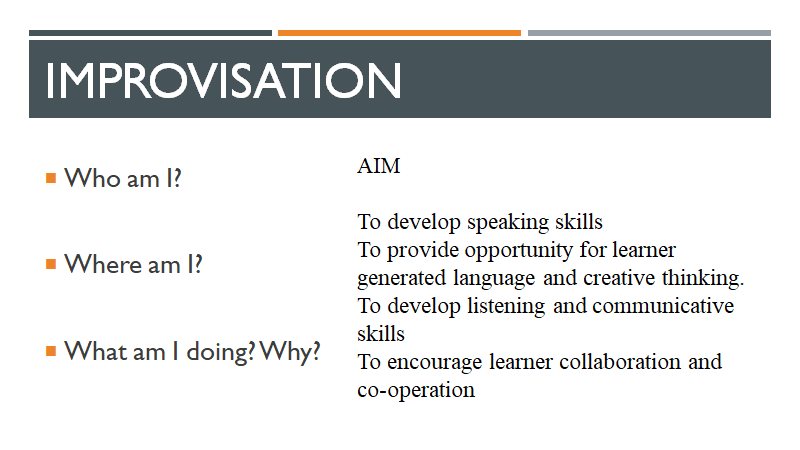
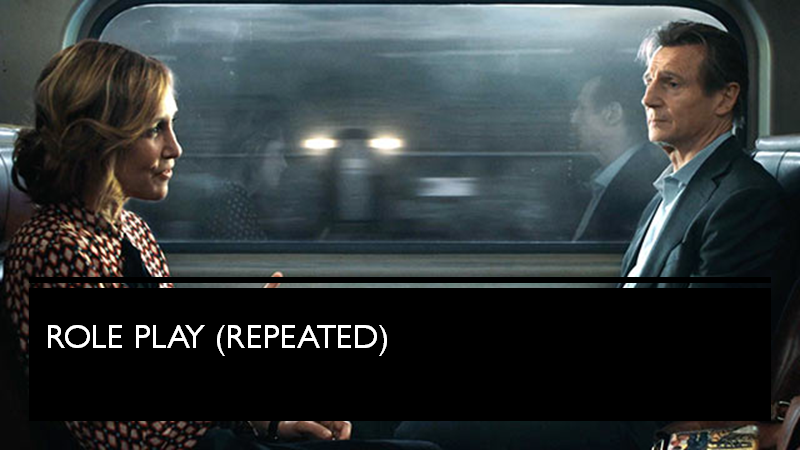
We can tell the learners that they are on a train. They are in character and they’re going to meet another character on the train. They need to introduce themselves and talk about the holiday that they have just been on. In order to get the learners engaged, you might want them to have suitcases or imagine umbrellas, hats and they start by walking down the train corridor and sitting down maybe putting the suitcase on the rack and then they start their improvised role play. A feature of role plays, is that the first-time learners do it will not be so effective because they are struggling to find words and they lack fluency. However, if you change the pairs and get them to do the same role play again it will improve and by the third time the role play will be considerably more fluent and effective. You may think that repeating the role play will be boring for the learners but because they are changing their partner it means that each new role play is a new experience. The responses they get from their new partner will not be the same as their previous partner. Although the role play structure, content, characters and phrases means they will be repeating similar things, there is an element of improvisation and creativity each time they do the role play.
Hot Seating
The next activity is called hot seating. In a drama class you have the learners sitting in a circle and you ask one learner to go into the middle of the circle and to adopt an attitude (for example – look sad) and then the other learners will be asked to write questions for that person. You can use a learner, or you can use a photograph. This is a photograph I have chosen of a young boy crying. After asking the learners to write four questions they would like to ask the little boy, in pairs or groups you get them to compare the questions and choose which ones they think they would like to ask. You will notice that some of the questions will be lower order thinking: ‘Is he crying?’ Some of them will be higher order critical thinking: ‘Why is he crying?’
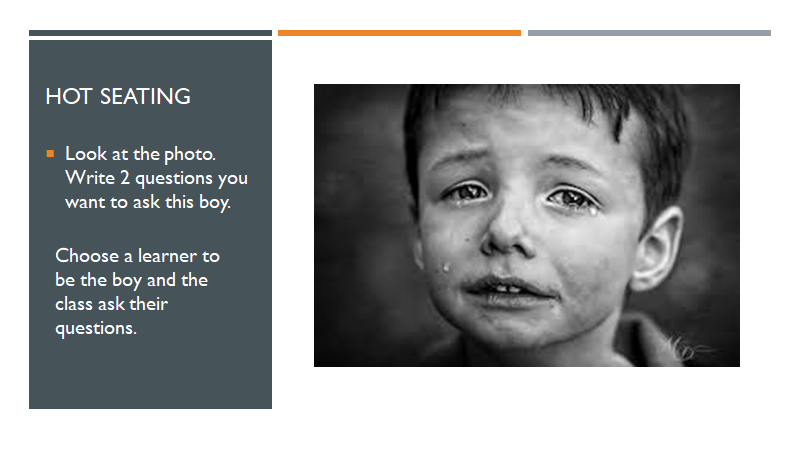
Then you will ask the learners in pairs or groups to ask the questions and the boy (one of your learners) replies in character. This is an effective way to stimulate questions and creative thinking and lead into an improvised speaking activity.
Thought Tracking
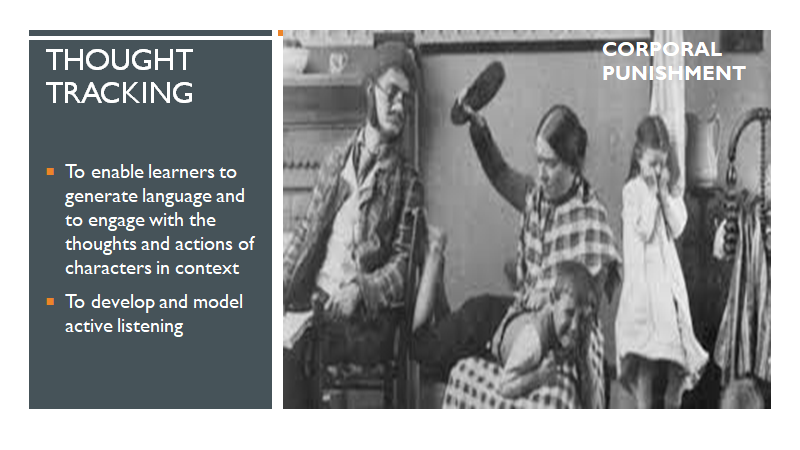
The next activity is called ‘thought tracking’. The teacher can start with a photograph of an interesting scene. For example here is a picture related to the theme of corporal punishment. I chose this because it links to the character of the boy crying and how he was punished by his mother. The learners look at the photograph and then create a frozen image (tableau) so one learner can be the mother, another the boy, the sister and the father. The teacher now asks them to think about what they are saying or thinking in this scene. Then the teacher or one of the learners can tap each of the characters in turn on the shoulder and they verbalise what they are thinking or what they are saying in the scene. This can be extended to a short sketch or dramatised scene. This activity allows learners to generate their own language and to engage with the thoughts and actions of characters in a certain context. It develops listening skills as well as speaking skills.
It is important to choose scenes that are relevant to the learners life and not to be afraid of choosing topics that may be controversial or get the learners emotionally involved. Personalization is a great motivator and typically drama has been used to address issues that are personal and complex. Augusto Baol the famous Brazilian dramatist created a concept called Forum Theatre to tackle social issues. It is used to address and resolve issues such as peer pressure, conflict resolution, bullying, drug / child abuse etc. Obviously you don’t want to make the topics very depressing and upsetting but also if there are issues that the learners are facing then it’s probably cathartic to address some of those issues depending on the age and maturity of your learners.
Conscience Alley
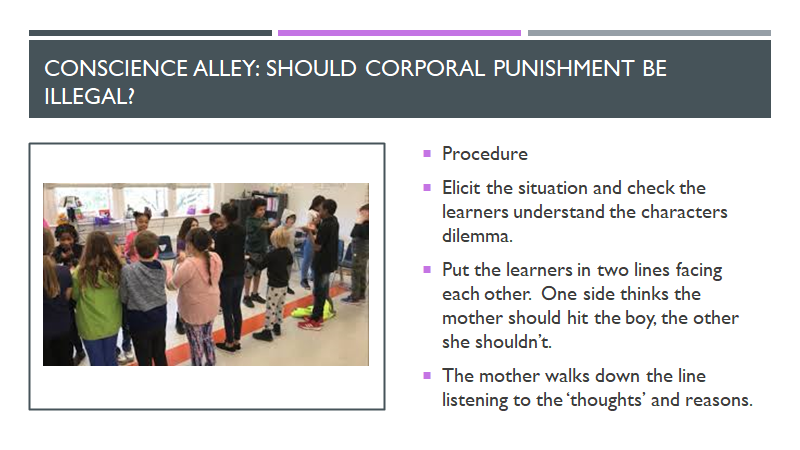
This leads us into the next activity which is called ‘the conscience alley’. In this activity you give the learners an ethical question for example if we continue in the same theme the question could be: ‘should corporal punishment be illegal?’ Put the learners standing in two lines facing each other and one side agrees with corporal and the other side disagrees and think that the mother shouldn’t hit the boy and Corporal punishment should be illegal. One of the learners can be the mother and you ask them to walk down the line of learners through the conscience alley and the learners whisper their opinions to the mother as she walks down. When the mother reaches the end of the conscience alley she can decide which side she thinks won the debate and the reasons why she chose that side.
The Mantle of Expert
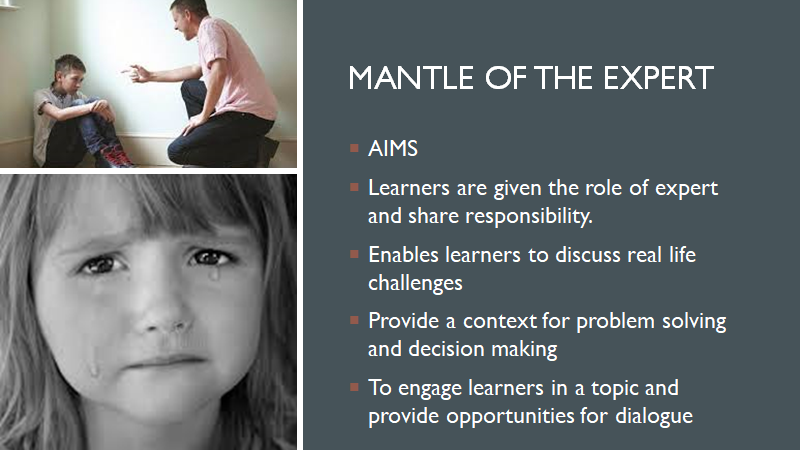
The final drama activity that encourages both critical thinking and language learning development is ‘The Mantle of the Expert’. This is essentially a simulation where the learners take on the role of experts. Examples include the model UN or a children’s parliament or when the children become the teachers for the day. The aim is to investigate topics that are relevant so for example:- climate change, the environment, human or animal rights, recycling etc. It provides a way of leading into project work and allows the learners to discuss real life challenges. It provides a context for problem solving and decision making and provides opportunities for engagement and dialogue in the target language. The teacher sets up the context by adopting a role. If we use the same theme as the previous activities thinking about corporal punishment and how to punish children when they misbehave, then the teacher walks into the classroom and says: ‘Good afternoon ladies and gentlemen. I’d like to welcome you all to this meeting. It’s great to see so many expert psychologists here today. As you are all very aware we are experiencing a pandemic and children are locked down in their houses. They cannot go out to play and this of course has led to boredom frustration. Parents are finding it difficult to keep their children engaged and motivated and very often this has led to misbehaviour by children. Here at the Institute of Psychology we’re getting a lot of inquiries from parents about how to cope. Our job ladies and gentlemen as child psychologists is to provide some advice and suggestions for parents which is why we have called this meeting today. So what I’m going to do is I’m going to put you into groups to discuss this issue and to see if in your group you can come up with a list of maybe five to six suggestions that parents can adopt that will help them through this difficult situation’.
Adopting ‘a teacher in role’ is a way of setting up a project which can lead to reading, listening, and speaking practice. It is good to choose a topic that the learners have some previous knowledge about or something that they are studying in other classes like history or geography.
Conclusion
Drama in general and the specific activities I have described, promote creative thinking and activate learners’ imagination. Drama encourages divergent thinking as it frees the learners to create their own characters, settings, roles and language. Divergent thinking allows for learners to generate their own ideas and language and as a result provides rich opportunities for receptive and productive skills development through activities that are creative, open ended and encourage learner centered interaction.

 Tom Godfrey
very helpful
thank you, sir