
What is praise?
Praise is identifying behaviour or progress and signalling approval. Everybody likes to be acknowledged in a positive way and people like to get positive feedback. So praise is essentially positive feedback to the learners acknowledging and approving their work or progress. Praise can come from the teacher, other learners or even self praise.

Why is praise important?
Praise can change expectations so learners can be encouraged to try harder, be more persistent and seek challenges it’s a very good way of building a positive atmosphere.

So how do we give praise?
There are three types of praise: one is personal praise where you’re praising the individual learner or group – ‘ohh well done Arzu you are fantastic,’ or group praise ‘well done you guys you’re awesome’. This kind of praise is not particularly effective because it’s too general. It’s praising people for being there and it doesn’t raise expectations. Indeed, if praise is not earned it can have a negative effect as it lowers expectations as the learner thinks – ‘yes I am fantastic, this is easy for me, I don’t need to try very hard and still the teacher says I am awesome’.

Praise needs to be more specific so learners know what they are being praised for so it could be effort based – it was a difficult reading with lots of new words but you stayed focussed – well done you you tried really hard but not ability based ‘you’re really good at reading’ because that doesn’t motivate learners to develop.

Praise can be behaviour specific – ‘Thank you Ahmet for cleaning the board, sitting quietly, helping you partner, you answered that question really well you included lots of ideas in your answer, you spoke for a minute and you used a lot of the new words we studied’.
so praise needs to be either effort based or behaviour specific and in this way we can increase motivation and raise expectations.
we need to be careful that we’re not praising inappropriately so we don’t want to praise behaviour that we expect we want to praise behaviour which is beyond our expectations.

If we praise too often the praise loses its value.
Who can give praise?
Usually we envisage the teacher giving praise, but learners can be encouraged to praise each other and self praise is possible.

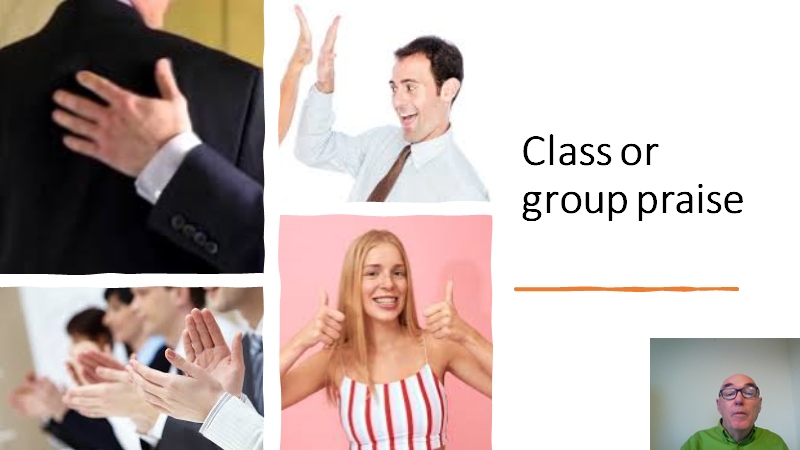
Class or group praise.
This can be done publicly and spontaneously after an activity as a feedback stage. It can be done orally with phrases such as: ‘Well done. You spoke well in the role play and you used the expressions you learned today. I am really pleased’. Or the teacher can show their appreciation with facial gestures (smiles of encouragement) or other gestures such as thumbs up, high fives. When a group has performed well, the teacher can ask other groups to applaud or after a productive day the teacher can ask everyone to clap: ‘Great work today. Let’s give ourselves a clap’ or ‘ give everyone in your group a pat on the back’.
Praise can be reinforced visually using a praise graphic or visual – it can be a ladder where you could have all the learners visually represented
-bees for example moving towards the hive
or butterflies moving towards a flower
When a learner makes special effort or behaves in a praiseworthy manner their butterfly moves to the flower.

You need to be careful that these methods are only used for praise –
some teachers use this visual image as a way of disciplining learners as well. So you move up the ladder to the flower when you’re behaviour is praiseworthy but then they move you down the ladder as a form of discipline when the learner is misbehaving, but in my opinion this is a mistake because there are some learners who actually want attention and they seek attention above anything else
so moving down the ladder or up the ladder
is not so important what they really want to be doing is to be noticed by the teacher and moving somewhere
so actually by moving them down the ladder you’re just giving them the attention they crave
which is the opposite of what you want. I just use the praise ladder visual to reward behaviour or work that is praiseworthy.
Teachers need to be careful as too much loud public praise can be ‘showy’ and create class competition. For example –
Many teachers when giving feedback will say ‘okay how how many got all the answers right?’ and students put up their hands. ‘Oh well done Luigi you got all the answers right okay who got one wrong two wrong’ etc
Now if you’re a learner who’s got more than two or three wrong you publicly admit your failure so this isn’t praise. This is a deficit model of feedback showing you that there is only one correct answer and even though you may have tried hard – you failed – so this isn’t increasing effort or encouraging learners.
More effective is to give an answer key and let individual learners check their own answers or each other’s answers in pairs and this encourages peer feedback and self-praise.

Private praise to individual learners is usually more powerful than public praise so if we go up to a learner and have eye contact, smile at them give them encouragement through our facial gestures and maybe privately whisper: okay that was that was a very good essay etc
Praise needs to be earned so you need to feel that you’re worthy of the praise and the praise is sincere and authentic praise. Some teachers use stars or other visual rewards.

Individual message can be written to the learner in their learning journals or a learning diary. saying okay yesterday I notice you did this.
Learners can be encouraged to praise each other. Learners can be given opportunities to comment on each other’s work in peer feedback.
Similarly learners can be given opportunities to reflect on their learning at the end of the lesson: what did you learn today? Or use the ‘can do’ statements to reflect on their progress. This is a form of self-appraisal
Rationale
This shows learners important principles about your teaching philosophy.
Praise can change expectations so learners can be encouraged to try harder, be more persistent and seek challenges. It is a very good way of building a positive atmosphere.
Praise needs to be either effort based or behaviour specific and in this way can increase motivation and raise expectations.
Praise needs to be earned, so you need to feel that you are worthy of the praise and the praise is sincere and authentic.
Key points.
To summarise the key points of giving praise
Praise can be public or private, spontaneous or delayed,
We can use facial gestures, gestures, high fives, thumbs up, clapping etc as well as oral praise.
Public praise can be reinforced visually with a praise graphic or stars
Private praise can be delayed and given on ‘hotcards’ or in the learners’ learning diary.
The teacher can encourage peer praise after group or pair work by using answer keys.
Learners can be encouraged to self-reflect using ‘can do’ statements.

 Tom Godfrey